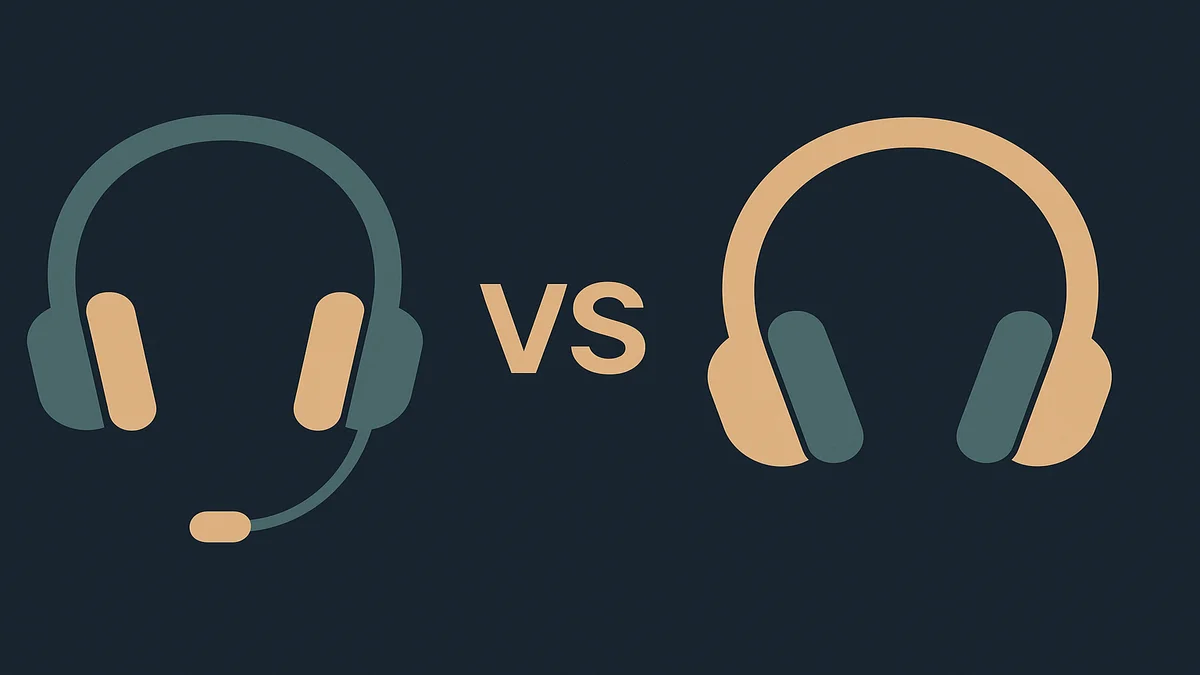
Headset Vs Headphones For Work
Headset vs headphones for work: at a glance
A headset is the right tool for hours of daily calls: a boom mic a fixed distance from your mouth keeps your voice consistent, from about $50 wired (Kensington H1000, $49.95) to around $250 business wireless (Jabra Evolve2 65, $249 MSRP). Headphones are right for hours of listening between calls: better sound and cancellation, mic as the compromise.

The two products overlap more than their marketing suggests, which is why this decision confuses people. Modern headphones include beamforming microphones and handle calls adequately; modern headsets play music tolerably. But the overlap is at the boundary, not the core, and each category is still visibly built around a different center of gravity: the headset around your voice arriving clearly, the headphones around what you hear. This piece compares both across the criteria that actually differ on a remote worker’s desk, then matches them to call-heavy, listening-heavy and mixed workdays. It sits inside our remote work tech coverage, and if your machine is the weak link in the call chain rather than the audio gear, our guide to laptops that can handle Zoom tabs and chaos covers that end of it.
Quick verdict
Customer-facing or call-heavy role: headset, no hedging, because mic consistency is the job. Deep-work-heavy role with a few calls a week: noise-cancelling headphones, because the listening hours outnumber the talking ones. Mixed role: headphones as the daily driver plus either a small desktop mic or a cheap wired headset for long calls is the combination that serves both halves without overspending on either.
This page may include affiliate links. If you buy through them, I may earn a commission at no extra cost to you. Picks follow the criteria in this article, not commission rates.
Head-to-head comparison
Same criteria for both, judged on a real remote workday: meetings, focus blocks, music, and the occasional noisy household.
Microphone quality and consistency
This is the core difference, so it goes first.
A boom mic wins on mechanics, not brand. It positions the microphone a fixed one to two inches from your mouth, which means your voice arrives at a consistent level and picks up less room noise by simple physics: the closer the mic is to the source, the louder your voice is relative to everything else in the room. Directional noise-cancelling boom mics (the Kensington H1000’s rotates 270 degrees and cancels noise directionally) are built around this. The result is the thing colleagues notice: you sound the same at hour one and hour six, leaning back or leaning in.
Headphones use built-in beamforming mics near the earcups, a foot or more from your mouth. Modern implementations are genuinely good: Sony’s WH-1000XM6 packs 12 microphones, and its call quality is a stated design goal. But the distance penalty is physics, not engineering, so your voice mixes with more room, and any consistent answer to that (arm position, head angle) becomes a habit you maintain on every call. On a quiet call, most people will not notice. On a noisy one, they will.
The honest comparison: for calls where being heard matters (client calls, sales, support, anything where your voice is the product), the headset’s mic consistency is a working advantage, not a spec-sheet one. For internal calls where an occasional “you cut out there” is survivable, headphones are fine.
Noise cancellation
Headphones win this, and it is their whole identity. Consumer flagships are built around active noise cancellation as the core feature: Sony’s WH-1000XM6 leads this category, and even budget models like Anker’s Soundcore Space One (around $100, per CNET’s value assessment) deliver useful cancellation. For remote workers in households with kids, deliveries, or street noise, this is the feature that protects focus hours, and it is the strongest argument for headphones on mixed days.
Headsets mostly offer passive isolation (sealing earcups or earpads) rather than the aggressive ANC consumer flagships have. Business headsets like the Evolve2 line sell on call reliability, all-day comfort and certifications rather than silence. Some higher-end models add ANC, but it is not the category’s center of gravity.
If your problem is hearing your meeting over a vacuum, the headset’s mic does not care, but your attention does; note that this cuts both ways depending on whether you are speaking or listening.
All-day comfort
Headsets have a structural comfort advantage for long wear: they are lighter and smaller. The Jabra Evolve2 65 duo weighs about 176 grams (6.2 ounces), and mono variants less, against roughly 250 to 260 grams for the Sony XM6 class of flagship over-ears. Lighter means less clamping force needed, less head-top pressure, and less fatigue across an eight-hour day. On-ear and mono headset designs go further: one ear free is a feature in a home with people in it, and it is why mono headsets persist in support and service roles.
Headphones answer with better padding and materials at the flagship level, and over-ear designs distribute pressure well, but they are built for listening sessions and commutes, not for ten hours of continuous wear while talking. If you wear your audio device all day every day, weight matters more than most reviews credit.
Sound quality
Headphones win, and it is not subtle. Flagship consumer headphones are engineered as audio products first: drivers, tuning, codecs. Work headsets are engineered for speech intelligibility in both directions, and their music playback ranges from acceptable to dull. If music or media is a real part of your day (background focus playlists, end-of-day decompression), the headphones’ advantage applies daily, while the headset’s mic advantage applies only during calls. Count your hours honestly; for many people the listening hours win.
Appearance and social context
The boom mic arm reads as “call center” or “support agent,” and on video calls it occupies your face’s frame. Headphones read as ordinary; everyone wears them. If you are on camera with clients, or you move between work and public spaces (coworking, cafes), the headphones’ neutrality is a real, if soft, advantage. The mono-headset middle ground (one earcup, slim arm) softens the look considerably, and many business headsets now fold and tuck the boom away entirely.
Price and value
The categories overlap at the low end and separate at the top. At the time of writing: wired USB office headsets start around $50 (the Kensington H1000 lists at $49.95); business wireless headsets run roughly $150 to $250 (the Evolve2 65 lists at $249 MSRP, commonly discounted toward $200); consumer ANC headphones run from about $100 in budget (Soundcore Space One, per CNET’s value assessment) to around $450 to $460 at the flagship (the Sony WH-1000XM6 lists at $459.99 MSRP). The practical takeaway: a very good work headset costs less than a flagship pair of headphones, because headset buyers are businesses that buy dozens and do not pay for studio-grade drivers.
Ecosystem and controls
Headsets integrate more tightly with work software: call answer/end buttons on the earcup that actually control the meeting app, mute indicators, busylight options on some models, and certifications (the Evolve2 line carries UC/Teams certification, per its positioning). Headphones control your media well and your calls partially, and mute is always a keyboard reflex. If you bounce between calls all day, the headset’s controls reduce fumbling, and that compounds.
Where headset wins
The headset wins when your voice is part of the work. Support, sales, teaching, coaching, any role with back-to-back calls: mic consistency, all-day comfort at lower weight, and call controls are the working toolkit, and a $50 to $250 headset delivers all three. The mono variants add situational awareness, which matters in a household with people in it.
It also wins on the unglamorous reliability layer: a device designed to be worn through consecutive calls does not run out of battery mid-meeting in the way a media device occasionally does, and its buttons do what the meeting expects.
Where the headset is honest about its limits: music sounds mediocre, ANC is not the point, and the boom arm has a look. If your calls are two a week, you are paying a comfort-and-mic premium for a problem you barely have.
Where headphones for work wins
Headphones win when listening, focus and looks matter more than mic mechanics. Deep work in a noisy household is the clearest case: strong ANC (Sony’s XM6 class, or the Soundcore Space One at budget) protects hours that no headset matches, and the same device carries your music and your occasional calls at a quality most colleagues will find perfectly fine.
They also win on versatility beyond work: travel, gym, media, and the simple fact that one device serves the whole day. And on camera, they disappear into the ordinary, which matters for client-facing calls more than people admit.
Where headphones are honest about their limits: mic consistency degrades in real room noise, they are heavier for all-day wear, and flagship prices ($460 MSRP for the XM6) buy audio quality that a work day does not require. If calls are your job, you are buying the wrong tool regardless of how good it sounds.
Which should you choose
Match the choice to your call load and your environment, in that order.
Choose a headset if:
- You spend two or more hours a day in calls, or your calls are with clients where being heard clearly is the deliverable.
- You wear your audio device most of the workday and weight fatigue is real.
- You want call controls and mute that work without touching the keyboard.
- Your budget is tighter than your call volume: a $50 wired headset solves the work problem completely.
Choose headphones if:
- Your day is deep work with a handful of calls, and noise cancellation protects more hours than a boom mic would improve.
- Music or media quality matters to you daily.
- You are on camera with clients and the boom-arm look bothers you, or you share the device with life outside work.
- You already own good headphones, in which case the marginal purchase is a microphone, not a headset.
The combinations that work:
- Headphones plus a small desktop or clip mic. The standard mixed-role answer: flagship listening experience, and a dedicated mic placed close for calls. Costs roughly the same as one good headset, splits the jobs cleanly.
- Headset at the desk, headphones for everywhere else. Common for call-heavy workers who also commute or cowork; the $50-to-$250 headset stays plugged in, the headphones live in the bag.
- Mono headset as the only device. The minimalist answer for call-heavy, house-with-people workers: one ear free, slim profile, worn all day without fatigue.
One mechanical note that applies either way: your audio chain is only as good as its weakest link, and the machine often is that link. If calls stutter or drop regardless of the mic, check the computer side in our guide to laptops for remote work, or the wider machine-type question in laptop vs desktop for work. Audio gear does not fix a struggling connection.
Pricing compared
Current list prices at the time of writing; verify before buying, because audio pricing moves weekly.
| Option | List price | What you get |
|---|---|---|
| Wired USB office headset (Kensington H1000 class) | $49.95 | Boom mic, noise-cancelling directional mic, USB-C, zero latency, no battery |
| Business wireless headset (Jabra Evolve2 65 class) | $249 MSRP, commonly discounted | Bluetooth with dongle, all-day battery, call controls, UC/Teams certification |
| Budget ANC headphones (Soundcore Space One class) | Around $100 | Useful noise cancellation, good call quality for the price, multipoint |
| Flagship ANC headphones (Sony WH-1000XM6 class) | $459.99 MSRP | Best-in-class cancellation, 12 mics, premium sound, 30-hour battery |
Two notes on these numbers. First, the $50 wired headset is the sleeper of this comparison: no battery, no pairing, no latency, and it solves the work problem outright, which makes it the right first purchase for call-heavy wor

Frequently asked questions
Is headset better than headphones for work?
For call-heavy work, yes: a boom mic sits close to your mouth, so your voice stays consistent and clear in noise, and headsets are lighter for all-day wear with controls that match meeting apps. For focus-heavy work with occasional calls, noise-cancelling headphones are better: stronger cancellation, much better sound, and a normal look on camera. Match the tool to whether your voice or your attention is the product.
When should I pick headphones for work instead?
Pick headphones when listening hours outweigh talking hours: deep work in a noisy household, daily music, and calls that are internal and occasional. They also win if you are on camera with clients and dislike the boom-mic look, or if you want one device for work and life. The compromise to accept is microphone consistency in genuinely noisy rooms.
Can I use headset and headphones for work together?
Yes, and it is a common setup. The typical shape is a headset for calls (wired at the desk, or a mono unit) plus noise-cancelling headphones for focus and travel, or headphones as the daily driver with a small dedicated microphone added for calls. Both combinations cost roughly what one premium device does and split the jobs cleanly.
Sources used
- Jabra, Evolve2 65 product page (business wireless headset positioning, UC/Teams certification): https://www.jabra.com/business/office-headsets/jabra-evolve/jabra-evolve2-65
- PCMag, Jabra Evolve2 65 review ($249 MSRP): https://www.pcmag.com/reviews/jabra-evolve2-65
- HeadsetAdvisor, Evolve2 65 vs Evolve2 75 comparison (duo model weight 176.49 g / 6.22 oz): https://headsetadvisor.com/blogs/headset/jabra-evolve2-65-vs-evolve2-75-comparison
- Kensington, H1000 USB-C On-Ear Headset product page (270-degree rotating noise-cancelling microphone, on-ear design): https://www.kensington.com/p/products/professional-video-conferencing/professional-headsets-and-accessories/h1000-usb-c-on-ear-headset/
- MacTech, Kensington H1000 USB-C Headset review ($49.95 price, directional boom mic): https://www.mactech.com/2022/09/01/review-kensington-h1000-usb-c-headset/amp/
- Sony, WH-1000XM6 product page ($459.99 MSRP, 12 microphones, up to 30-hour battery, call quality positioning): https://electronics.sony.com/audio/headphones/headband/p/wh1000xm6-b
- CNET, Best noise cancelling headphones (Soundcore Space One as a good value around $100): https://www.cnet.com/tech/mobile/best-noise-canceling-headphones/